
Flag Football Defensive Back
D1: 5-3 to 5-8, 115–150 lbs. College recruiting standards and the complete guide for flag football defensive backs.
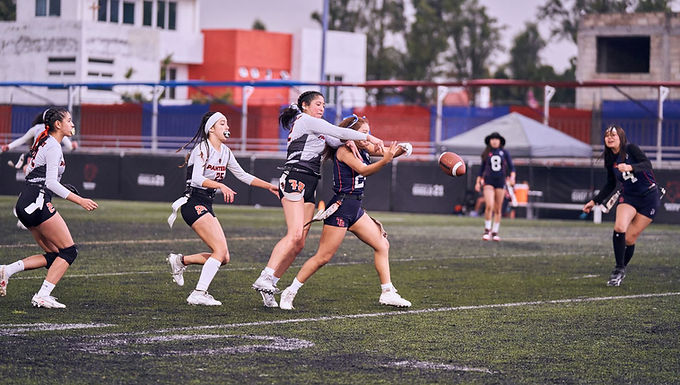
High school girl playing flag football as defensive back pulling a flag, flags visible at her waist
RECRUITING STANDARDS BY LEVEL
Flag Football Defensive Back
A flag football defensive back covers the fastest players on the field in open space. There is no tackling and no jamming with contact in flag football — she wins with speed, coverage technique, and pulling a flag in the open field the moment a receiver catches the ball. College coaches recruit defensive backs who stay in phase, break on the ball, and end plays with a clean flag pull.
TALENT
Coverage comes first: a clean backpedal, turning and running with a receiver, staying in phase, and reading the quarterback's eyes and route breaks. Flag pulling in the open field is the finishing skill — good angles, closing speed, and a low, balanced pull. Ball skills matter too: breaking on the ball, interceptions, and pass breakups without contact. Speed and agility show up in her 40-yard dash time, her shuttle, and her change of direction. Versatility helps as well — covering slots, playing zone, and adjusting to different receivers.
CHARACTER
A defensive back needs a short memory. She will get beaten, and she must reset for the next play without losing confidence. Coaches look for composure after giving up a catch, competitiveness on every snap, and communication in the secondary. She should be coachable about her technique and footwork, and a strong teammate and a reliable student.
ACCOMPLISHMENTS AND PERFORMANCE METRICS
Coaches look for interceptions, pass breakups, flag pulls, and few completions allowed, all in context. Production in a state-sanctioned high school flag league, at NFL FLAG events, and in USA Football pathway tournaments weighs far more than numbers against weak competition. Her film must show coverage, open-field flag pulls, and picks, so a coach can see her cover and finish plays. All-league and all-state honors and strong national-tournament performances help when the film and the competition behind them are strong. The typical top-end defensive back is 5-3 to 5-8, 115–150 lbs. Coaches will recruit a slightly smaller defensive back with elite speed and ball skills, and pass on a taller one who cannot stay in phase or pull a flag in the open field.
DIFFERENCES ACROSS LEVELS
Here is the honest picture for girls' flag football today. The NCAA does not sponsor flag football championships yet — flag football is an NCAA Emerging Sport for Women — so there are no NCAA Division I flag football programs offering scholarships the way D1 programs do in other sports. NCAA programs today are at club or emerging status. The real scholarship pathways in flag football right now are NAIA varsity programs — the main scholarship home for the sport, with about 30 programs and growing — and NJCAA junior colleges. The D1, D2, and D3 ranges below describe the top-end athlete standard, the size and athleticism of the best players at each level, and they are a useful measuring stick for where a defensive back stands. The typical D1-standard defensive back is 5-3 to 5-8, 115–150 lbs. The typical D2-standard defensive back is 5-2 to 5-7, 110–145 lbs. The typical D3-standard defensive back is 5-1 to 5-6, 105–140 lbs. The typical NAIA defensive back is 5-1 to 5-6, 105–140 lbs, and the typical JUCO defensive back is 5-2 to 5-7, 110–145 lbs. A defensive back's best plan is to build her target list around NAIA varsity programs and NJCAA junior colleges, where the scholarships are today, while keeping an eye on NCAA emerging programs as the sport grows — and to match that list honestly to her film, her production, and the level of competition she has already handled.
HOW TO STAND OUT
Open your film with coverage and flag pulls against good receivers. Play in a state-sanctioned league, at NFL FLAG events and USA Football pathway tournaments, and at national tournaments where coaches watch. Work on your backpedal and turn, your 40 and shuttle times, your angles in the open field, and your flag-pulling technique. Develop a specialty — lockdown coverage, ball skills, or open-field flag pulls. Reach out early with a short, honest note, a two- to three-minute highlight film and full game film, and follow up after tournaments. Keep your grades strong, because academics open doors at every level.
CONCLUSION
A recruitable flag football defensive back covers in phase, breaks on the ball, and ends plays with a clean flag pull against strong competition, not just on a stat sheet. If her coverage, speed, ball skills, and character all point the same way, college coaches will notice her. The defensive backs who get recruited are rarely the ones waiting to be found; they are the ones playing in the right leagues and tournaments, sending the right film, and improving the parts of their game that coaches actually evaluate.
THE ROLE OF LANCE O'S RECRUITING NETWORK
Lance O's Recruiting Network helps flag football defensive backs turn talent into a real recruiting plan. The network helps a player understand where she fits across the NAIA and NJCAA pathways — and what the NCAA emerging status means for her — build a target list of programs that match her game and her academics, and present herself the way college coaches want to see her: with honest film, a clear highlight reel, and direct, professional outreach to coaches. It also helps her choose the right league and tournament schedule, prepare for NFL FLAG and USA Football pathway events and showcases, and stay organized through the process, from first contact to campus visits to a final decision. For a defensive back, that guidance matters because coverage alone is not enough: the right plan puts her coverage and flag pulls in front of the right coaches, at the right events, at the right time.